
Lead in drinking water is a serious concern for families, especially in older homes. Both the Environmental Protection Agency (EPA) and the Centers for Disease Control and Prevention (CDC) confirm that no amount of lead is safe in a child’s blood.
This potent neurotoxin is invisible, tasteless and odorless. Your water can appear perfectly clear yet still be contaminated. As you research filtration options, you’ve probably encountered conflicting marketing claims, making it hard to choose the right solution.
This guide offers a clear, definitive answer to the question of whole-house vs. point-of-use lead filters. You’ll discover the most effective and cost-efficient way to remove lead from your family’s drinking water, empowering you to make a confident decision and find peace of mind.
Choosing the Right Lead Water Filter
To remove lead from your family’s drinking and cooking water, water treatment professionals often recommend point-of-use (POU) filters. Lead typically enters water from service lines or household plumbing. Targeted filtration at the tap offers a highly effective point of defense.
A POU system is also a cost-effective solution, as it focuses investment on protecting your drinking water rather than treating all household water.
Here’s why POU filtration is often recommended for lead reduction:
- Last-minute protection: Filtering at the tap minimizes the risk of recontamination from household plumbing.
- Targets the real source: Most lead originates from pipes, faucets and fixtures — not the municipal water supply.
- Boiling doesn’t help: Boiling water does not remove lead — it can actually concentrate it.
Certified lead-reduction filtration is one of the most reliable ways to safeguard your family’s drinking water quality.
POU vs. Whole House Filters
Learning the distinctions between POU and whole-house filters informs your decision. Both systems can coexist in the same home. The ideal filtration system depends on the specific contaminant you need to address.
POU Filters
POU filters are installed at a single location, typically under the kitchen sink. They purify water specifically for drinking and cooking. Common types include reverse osmosis (RO) and activated carbon filters.
RO units use multiple filtration stages to effectively reduce lead while enhancing taste and odor.
Activated carbon filters can reduce certain contaminants when certified for lead removal. Filter maintenance is straightforward and essential for performance — replace cartridges on schedule to ensure ongoing effectiveness.
Whole-House Filters
Whole-house filters — also called point-of-entry (POE) systems — are installed where the main water line enters the home. They treat water for every tap, shower and appliance.
Key considerations for whole-house systems:
- High-volume treatment: POE systems handle water use throughout your property.
- Common pairings: These systems work well with water softeners or sediment pre-filters.
- Higher operating costs: Treating more water increases filtration demands and expenses.
- Better for widespread issues: POE systems excel at addressing problems like hard water or chlorine that affect multiple fixtures.
For targeted lead removal in drinking water, whole-home water filtration systems are generally less practical than point-of-use solutions. They are best suited for water quality issues affecting the entire property.
Lead Filter Cost and Effectiveness
When comparing lead filter systems for home safety, consider effectiveness, cost and overall household protection. Both initial installation and long-term operating expenses are crucial considerations. Targeted filtration frequently offers a superior return on investment for contaminant-specific issues.
Filter Effectiveness
POU filters offer greater lead reduction effectiveness as they provide a targeted solution. They remove contaminants right before consumption.
Here’s what makes POU filtration more effective:
- Handles various lead forms: Lead contamination manifests in various forms and particle sizes.
- Strong reduction rates: Properly installed RO systems can reduce lead by up to 99%.
- Maintenance matters: Effectiveness depends on correct installation and timely cartridge replacement.
Whole-house systems treat all water entering your home, often unnecessarily if lead is only a concern at drinking taps.
Cost of Whole-Home Lead Filtration Systems vs. POU Filters
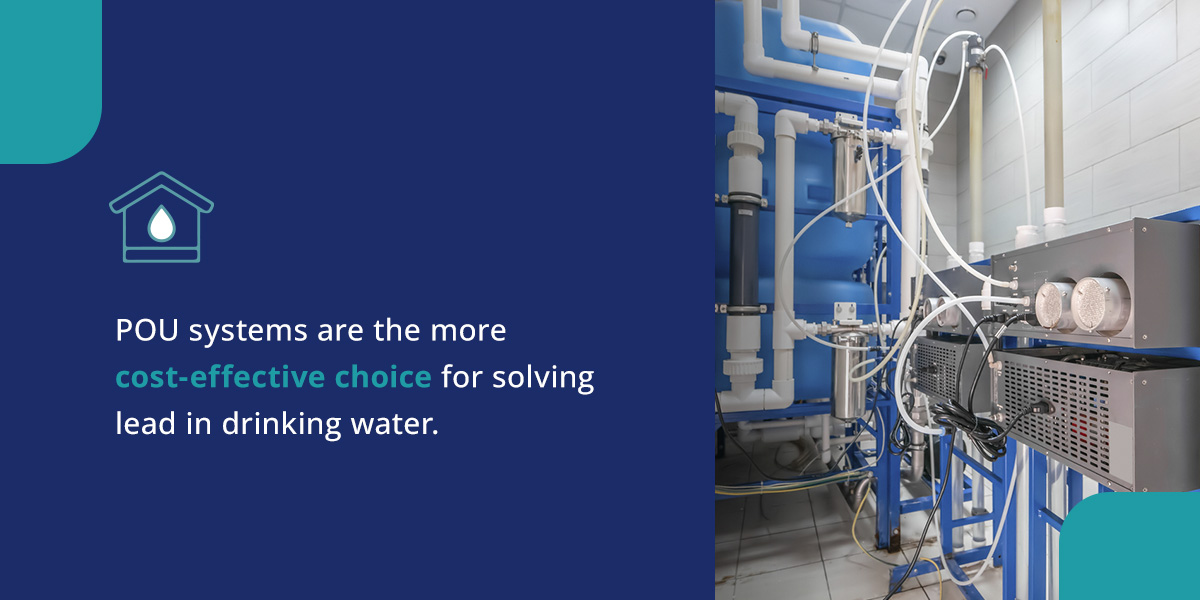
POU systems are the more cost-effective choice for solving lead in drinking water. This isn’t about choosing the cheapest option — it’s about choosing the right one. Replacement filter costs are predictable and manageable.
Consider these cost factors:
- POU affordability: A RO unit can cost a few hundred dollars to install.
- POE expenses: Whole-home systems generally involve higher up front and maintenance costs.
- Service line replacement: Lead pipe replacement can cost thousands of dollars.
- Lifetime ownership: Always consider the total cost over time, not just the purchase price.
Evidence strongly supports POU RO as one of the most practical and affordable lead filtration strategies for old homes.
Protection Against Lead Exposure From Tap Water
Certified filtration significantly reduces exposure to lead originating from compromised plumbing. Infants and young children are particularly vulnerable to lead exposure, which can impair cognitive development and learning abilities.
Preparing meals with unfiltered tap water also contributes to exposure risks. A certified point-of-use (POU) filter offers an effective way to minimize lead exposure during drinking and cooking.
When to Choose a Whole-House Filter
Whole-house filtration is ideal for broader water quality and infrastructure challenges. Many households benefit from comprehensive treatment strategies that improve comfort and safeguard plumbing performance.
Solving Hardness and Chlorine
POE systems effectively address aesthetic or widespread water quality issues throughout your home. Whole-house filters commonly resolve:
- Hard water scale: Mineral buildup that accumulates on fixtures and appliances.
- Chlorine taste and smell: Aesthetic concerns impacting showers, baths and drinking water at multiple taps.
- Sediment problems: Sediment that clogs fixtures and reduces water pressure.
- Skin and hair issues: Chlorine and hard water often contribute to dry skin and spotting.
Since these issues affect multiple areas of the home, POE treatment often offers a practical and comprehensive option. Customized solutions can address your home’s specific water quality concerns.
Protecting Plumbing and Appliances
Removing hard water minerals and sediment prolongs the life of water heaters, dishwashers and pipes. Here’s how whole-house filtration safeguards your home:
- Reduces scale buildup: Filtration prevents mineral deposits from damaging appliances and plumbing.
- Improves efficiency: Appliances perform optimally without sediment and scale interference.
- Extends lifespan: Reducing scale and sediment minimizes maintenance needs and defers replacement.
Investing in a whole-home filtration or water softening system protects your home’s infrastructure.
Understanding Certified Lead Filters
Gain confidence in your filtration choice by understanding how to verify product claims. Always prioritize independent certification over mere packaging or marketing language. Be aware that uncertified filters might enhance taste but fail to adequately reduce lead.
NSF Certified Lead Water Filters
The NSF/ANSI 53 standard specifically verifies a filter’s ability to reduce lead and other health-related contaminants. It is essential to note that NSF/ANSI 53 focuses on health-related contaminants, such as lead, whereas NSF 42 primarily addresses taste and odor issues.
Certification applies to the entire filtration system; therefore, individual components alone do not guarantee performance.
Your Next Steps to Safer Water
The essential first step is always to know what’s in your water. Note that homes built before 1986 are more likely to contain lead pipes, fixtures or solder. Professional lead water testing and removal guidance clarifies exactly which contaminants are present, informing your filtration system choice. DIY kits often lack the reliability of lab analysis, and accurate test results form the foundation for effective water purification.
A specialist can accurately interpret test results, assess your home’s plumbing and recommend an appropriately sized system. Key benefits of working with an expert include tailored recommendations, accurate system sizing and proper installation.
Book Your Free Water Test With Long’s EcoWater Systems Today

You don’t have to navigate lead filtration decisions in isolation. Long’s EcoWater Systems has assisted Greater Lehigh Valley homeowners with water quality challenges since 1949.
We provide a free, no-obligation in-home water analysis to precisely identify your water’s composition. Following this, our experts recommend a customized solution tailored to your home’s plumbing and water conditions.
Ready to take the first step toward safer water? Schedule your free water test today.