
Pennsylvania’s limestone bedrock causes high water hardness in the Greater Lehigh Valley, making a water softener essential to avoid common hard water problems like scale buildup, soap scum and appliance damage. Choosing an appropriately sized system for your household is easy when you partner with an expert. This guide walks you through the three factors that determine what size water softener you need.
How to Know What Size Water Softener to Buy
Knowing what size water softener you need comes down to three considerations — how much water your household uses daily, how hard your water is and the grain capacity needed to handle that demand efficiently.
1. Your Daily Water Use
The first variable in determining what size softener you need is your household’s daily water consumption. The average American uses approximately 82 gallons per day at home, according to the Environmental Protection Agency (EPA). To estimate your household’s daily water use, multiply 82 gallons by the number of people in your home.
If your household runs multiple loads of laundry daily, takes longer showers or frequently hosts guests, add a 10% to 15% buffer to your daily estimate to avoid undersizing. For heavy-use households, multiply your daily estimate by 1.1 to 1.15 as a sizing buffer.
2. Your Water Hardness Level
Measured in grains per gallon (GPG) or milligrams per liter (mg/L), water hardness is the concentration of dissolved minerals like calcium and magnesium in your water. The U.S. Geological Survey (USGS) defines four water hardness classifications:
- Soft (0-60 mg/L or 0-3.5 GPG)
- Moderately hard (61 to 120 mg/L or 3.6-7 GPG)
- Hard (121 to 180 mg/L or 7.1-10.5 GPG)
- Very hard (over 180 mg/L or over 10.5 GPG)
Pennsylvania water averages approximately 7 GPG, which falls into the hard classification. If you’re on city water, you can find your hardness level in your municipal water utility’s annual water quality report. Well water customers need a professional water test to get accurate iron and hardness readings before sizing their systems.
For well water customers, iron content also affects softener sizing calculations. Industry standards typically adjust for iron content by adding 3 to 5 GPG for every 1 mg/L of iron present in your water, with most experts using a factor of 3. This adjustment accounts for the additional load that iron places on the softener resin.
3. Grain Capacity
When you know your daily water use and water hardness, you can determine your required grain capacity. Multiply the number of people in your household by 82 gallons, then multiply that result by your water hardness GPG to get your daily grain requirement. Multiply the daily grains by seven to calculate the weekly capacity your softener needs to handle.
For example, four people × 82 gallons × 10 GPG = 3,280 grains per day. Multiply that by seven days, and you get 22,960 grains per week, making a 32,000-grain softener the right choice.
A softener’s rated grain capacity — such as 32,000 grains — is its maximum, not its ideal operating point. For efficient salt use and consistent soft water, size to 70% to 75% of the rated capacity. If your calculation puts you near a capacity boundary, round up to the next tier rather than trying to squeeze the exact number out of a smaller tank. The regeneration sweet spot is seven to 10 days between cycles for efficiency.
How Many Water Softener Grains Do You Need?
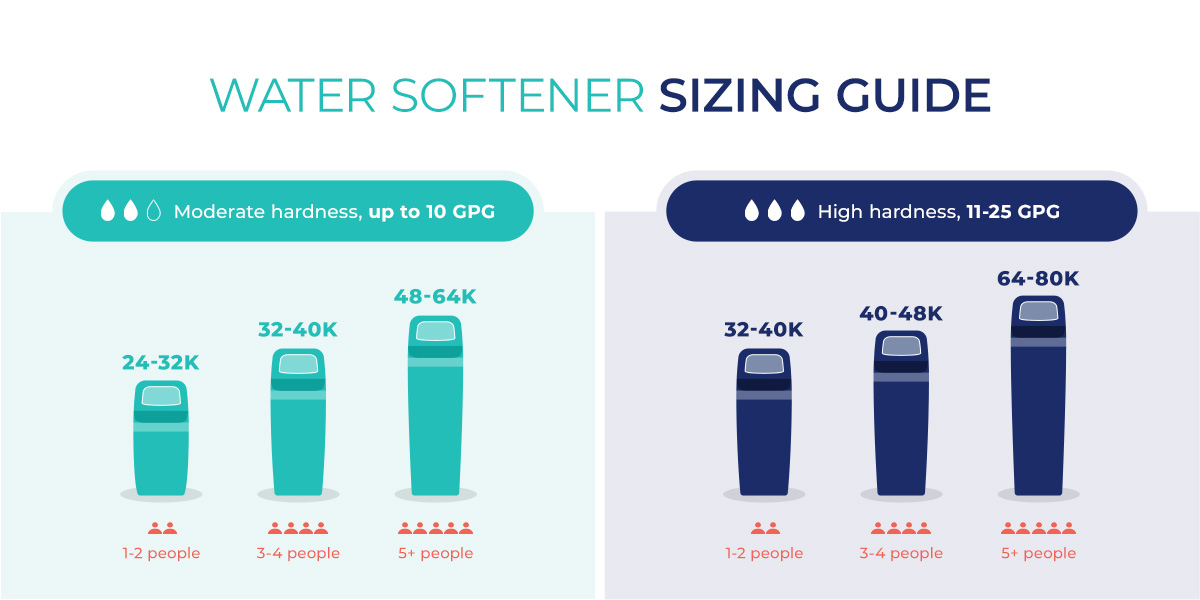
Use these practical guidelines for choosing a grain capacity.
For one to two people, and a water hardness of up to 10 GPG, aim for 24,000 to 32,000 grains. If the hardness is higher, up to 25 GPG, you’ll need 32,000 to 40,000 grains.
If your home accommodates three to four people, and has a water hardness of up to 10 GPG, you need 32,000 to 40,000 grains. Higher hardness levels of 11 to 25 GPG mean upgrading to 40,000 to 48,000 grains.
Larger systems, covering five or more people, with a water hardness of up to 10 GPG, benefit from 48,000 to 64,000 grains, while higher levels need 64,000 to 80,000 grains.
Choosing the Right Water Softener for Your Home
Once you know what size water softener you need, your next decision depends on your water source. City water and well water need different system types to address their unique characteristics.
City Water
City water is treated at the municipal level, but typically contains chlorine alongside hardness minerals. The EcoWater Refiner is designed specifically for city water. It addresses both issues by softening your water through calcium and magnesium removal, while also removing chlorine for better-tasting, cleaner water throughout your home.
The refiner also offers efficiency advantages that reduce operating costs. It uses 50% less salt than traditional softeners and features demand-initiated regeneration, which means it only runs a cleaning cycle when needed based on actual water use. This reduces both water and salt waste while ensuring you always have soft water available.
Well Water
Well water in eastern Pennsylvania commonly contains iron, manganese and sediment, which need additional filtration beyond basic softening. The EcoWater Conditioner is a water softener designed specifically for well water that also provides extra filtration for sediment and iron. It does not remove bacteria or chlorine, and iron levels directly affect grain capacity calculations, so professional testing is critical for accurate sizing. The conditioner is available in single- or double-tank configurations depending on your water quality needs.
Different Types of Water Softeners
Understanding the various kinds of water softeners and how they differ can help you determine which model is right for your home. Explore the primary types below:
Refiners and Conditioners
Water refiners and conditioners are both useful systems for softening hard water. However, they serve slightly different purposes.
A water refiner is best suited for households that get their water from the public supply since they effectively remove chlorine. A water conditioner actively removes iron, manganese and sediment, making it a great choice for homes with well water.
One-Tank and Two-Tank Systems
Water softener systems typically have one or two tanks. A one-tank model features a brine tank within the salt tank, giving it a compact design that requires little space. The tanks are separated in a two-tank system, giving homeowners more flexibility and a higher capacity for households with high water usage or especially hard water.
Timed vs. Demand-Control Models
As you explore different types of softeners, you’ll find timed models that operate on a schedule according to the settings on its programmable clock. These are excellent for households that consume a lot of water because they automatically regenerate whether or not the system requires flushing, ensuring there is always soft water in your home.
However, a demand-control model contains sensors that monitor the water and detect when the system softens a specific number of gallons. They are best for households with fluctuating demands and lower water usage.
Wi-Fi-Enabled Models
You can also find Wi-Fi-enabled water softeners that utilize automation and sensors to share important updates and notifications about your system. These models flag different factors, such as excessive water usage, low salt alerts, service reminders or system errors.
Sizing Water Softener Systems With a Professional
You can perform the necessary calculations on your own, use a specialized water softener size calculator, or you can ensure you get a system that is perfectly suited for your home by working with a professional.

When you’re calculating the correct size for your water softener, a professional water test and treatment solution is your best bet. An expert can accurately determine factors like water hardness and grains per gallon and then guide you through the buying process.
Be sure to work with a professional who is well-versed in water softening systems and has experience calculating system sizes. Explore testimonials and reviews from past customers, and only partner with credible, certified businesses that are experts in water softening, like Long’s EcoWater Systems, Inc.
Signs Your Water Softener May Be the Wrong Size
If you install a water softener but suspect it’s not sized correctly, watch for these warning signs:
- Hard water symptoms persist: Continuing soap scum, scale buildup or spotty dishes indicate your system can’t keep up with demand.
- Regenerating too rarely or frequently: Regenerating more than once a week signals an undersized system, while less than every 10-14 days suggests oversizing.
- Rapid salt depletion or reduced water pressure: Going through salt faster than expected indicates sizing or efficiency issues, as do pressure drops during peak use times.
If these signs sound familiar, a professional sizing assessment can identify the issue and recommend a solution.
Get the Right-Sized Water Softener With Long’s EcoWater
You don’t need to calculate water softener sizing alone. Long’s EcoWater Systems has been the Greater Lehigh Valley’s trusted water treatment experts since 1949 — locally owned and operated, and the area’s only authorized EcoWater dealer. Our certified water treatment technicians start with a free in-home water test that measures your actual hardness, iron content and other local water factors before recommending a custom solution tailored to your needs.
EcoWater products are made in the USA and backed by Berkshire Hathaway. Contact Long’s EcoWater today for a free water test and consultation.